Hand Control Adaptive Equipment for Minivan Conversions, Full Size Conversion Vans and Handicapped Vans
Webpage Contents
- What is Hand Control Adaptive Equipment?
- There Are So Many Styles of Hand Control Adaptive Equipment to Choose From, Which is the Best?
- What Should You Do Prior to Getting a Set of Hand Control Adaptive Equipment?
- Vehicle Installation Requirements for Hand Control Adaptive Equipment
- Federal Motor Vehicle Safety Standards FMVSS Affected by Hand Control Adaptive Equipment
- If I Get a Set of Hand Control Adaptive Equipment Installed, How Will Other People Drive My Car?
- Driver Safety Considerations with Hand Controls
- Other Vehicle Adaptive Equipment Usually Installed when Installing Hand Controls
- Available Styles of Hand Controls
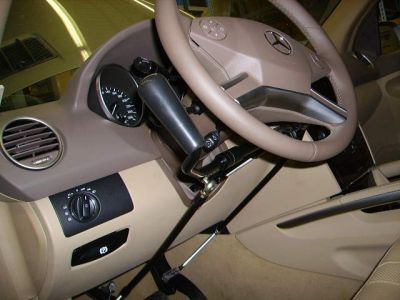
Howell Ventures Sure-Grip hand controls installed

What is Hand Control Adaptive Equipment?
Hand control adaptive equipment are products designed to allow the driver to operate the accelerator and brakes controls of their car using their hands when they cannot do so safely using their feet. Hand control adaptive equipment are mechanical in nature and typically consist of rods or wire linkages attached to the gas and brake pedals on one end. The rods or wire linkages are attached on the other end to a handle assembly which is mounted to the steering column. The handle assembly is attached to the vehicle's floor and not to the steering column on floor mounted styles. The hand control adaptive equipment handle is used to operate the gas and brakes through the rod or wire linkage. Pushing the hand control adaptive equipment handle forward operates the car’s brakes in all styles. Pulling straight back, pushing downward towards the lap, rocking the handle backward, or twisting the hand control adaptive equipment handle operates the car’s accelerator. Note: We will discuss electronic or hi-tech hand controls in another section of this website. Hand control adaptive equipment is installed in vehicles with power brakes, power steering and automatic transmissions. They are available in different styles of operation. In the last year, hand control adaptive equipment manufacturers have expanded their offerings to the point that just about all hand control adaptive equipment manufacturers make a version of their hand control adaptive equipment for each style.
There Are So Many Styles of Hand Control Adaptive Equipment to Choose From, Which is the Best?
There is no one single style of hand control operation that is better than another. The choice of the style of hand control should be based on the client’s abilities, comfort in using the style of hand controls, ability to operate secondary functions, and price. Some other factors which might rule out certain styles of hand controls are your size and the driving compartment size. The ideal way to find out which hand control you like is to test drive with various styles during an on road evaluation.
Hand control adaptive equipment is mounted for left hand use and is mounted to the left side of the steering wheel except for the floor mounted versions of hand control adaptive equipment which is generally mounted on the right side of the driving compartment. Floor mounted hand control adaptive equipment can be mounted on the left or right side so that is one advantage of that style. Whether to mount the floor mounted hand control adaptive equipment on the left or right side will depend on how you are entering the vehicle (if through the driver side door, left mounted hand controls whether steering column or floor mounted might get in the way) and which arm has more functional ability (generally you steer with the more functional arm). A driver rehabilitation specialist will help you determine this at an evaluation. Different style grips can be installed on the hand control adaptive equipment to meet client needs such as a Tri-pin or V-grip. Operation of the vehicle's secondary controls is also an important consideration because one hand will normally be dedicated to steering and the other to operating the hand control. Neither hand can be removed from the primary control it is operating (at least not for very long) in order to activate a secondary control switch. There are numerous ways to control secondary functions that will be covered on another part of this website, but usually the easiest method is to transfer switch operation of the essential secondary functions to the hand control itself. This prevents the hand that is operating the gas/brake from having to come off of the hand control in order to operate the secondary control. Turn signals, dimmer, or horn switches (usually a maximum of two functions) can be relocated to a switch(es) mounted on the handle of the hand control. Depending on the model of hand control being used, the Menox hand control can control brake latch, cruise control, horn plus turn signals, headlight dimmer, and windshield wiper. The Howell Ventures Sure-Grip hand control can also accommodate the Sure-Switch which can control up to four secondary functions using a small joystick type switch. In addition up to two of the four position joystick switches can be mounted on the Sure-Grip hand control. Again, the secondary functions that need adaptation and how that is accomplished is something that a driver rehabilitation specialist will help you determine at an evaluation.
What Should You Do Prior to Getting a Set of Hand Control Adaptive Equipment?
It is an industry best practice that a driver rehabilitation specialist prescribe the style and model of hand control that best meets your needs and vehicle. The majority of the adaptive equipment installers follow this practice. NMEDA Guidelines mandates that all members follow this practice. You must also be properly trained on the hand control adaptive equipment that you will be using. The style of hand control must meet your abilities to physically operate the control. Most installers will require all of the following prior to agreeing to install a set hand control adaptive equipment in your vehicle:
1. The vehicle has been inspected and is in good mechanical condition.
2. The hand control adaptive equipment is prescribed by a driver rehabilitation specialist, preferably a certified driver rehabilitation specialist.
3. You have been properly trained with the hand control adaptive equipment so that driving out of the installer’s shop isn’t the first time you’re actually driving with hand controls.
4. That you have the proper state driving license with any necessary restrictions. Many states require a license restriction to be placed on a valid driver’s license that requires the licensee to only drive in a vehicle with the proper adaptive equipment.
Vehicle Installation Requirements for Hand Control Adaptive Equipment
Hand controls are only installed in cars with power brakes, power steering and automatic transmission unless otherwise authorized by a certified driver rehabilitation specialist.
The vendor should also:
-
Road test the car using both the OEM gas and brake pedals and the hand controls to ensure the hand controls do not interfere with any other driving control system through the full range of motion.
-
Ensure the hand controls do not interfere with or restrict visibility to any other vehicle equipment such as the headlight switch, steering wheel, etc.
-
Ensure the hand controls do not interfere with a non disabled drivers ability to operate the vehicle using the OEM gas and brake pedals. The hand controls should never attach directly to the pedals themselves.
- The gas and brake shall automatically return to the neutral position after the hand controls are released. Note: brakes especially can be a problem and will drain your battery if the brake light does not turn off.
- If the knee bolster air bag must be removed in the course of the installation, that it is done so properly and the airbag is properly shunted.
- If the car has power adjustable gas and brake pedals, the feature is disabled.
Federal Motor Vehicle Safety Standards FMVSS Affected by Hand Control Adaptive Equipment
The vehicle modifier should take an exemption in the course of installing hand controls of a vehicle for:
FMVSS 208 - OCCUPANT CRASH PROTECTION - Main point of this exemption is that it permits vehicle modifiers to remove and/or deactivate all airbags for the front row designated seating position modified, provided Type 2 or Type 2A seat belts meeting the requirements of 49 CFR 571.209 and 571.210 are installed at that position. Since the exact impact of hand controls in a vehicle crash is such an unknown, the exemption also waives certain occupant crash protection requirements.
If I Get a Set of Hand Control Adaptive Equipment Installed, How Will Other People Drive My Car?
It is the non disabled driver who attempts to operate the vehicle using the hand control adaptive equipment that causes the majority of the hand control adaptive equipment related accidents. Howell Ventures Sure-Grip hand controls use a simple mechanical lock out design to prevent untrained drivers (family members, mechanics, etc.) from attempting to drive the vehicle using the hand controls. Never allow anyone to drive your vehicle using the set of hand controls unless they are thoroughly trained and licensed to do so. Even if it's just to do something like backing up the car out of the garage, unfortunately deaths and property damage have occurred when untrained family and friends attempt to use the hand controls to drive the vehicle.
The hand controls should never interfere with a non disabled person’s ability to operate the vehicle using the OEM (vehicle’s original) gas and brake pedals. The hand controls are not removed, they stay in place and must not interfere with the steering wheel operation. The hand control linkages must also be attached to the gas and brake pedal linkages such that there is no chance a driver's foot will get caught or prevented from moving their foot between the pedals. This is a very important point that you and the DRS will need to check during the installation process. If pedal guards are installed along with the hand control adaptive equipment, then the non disabled driver must be trained on how to properly remove and reinstall. Once the pedal guard is removed, the non disabled drive must use the OEM gas/brake to operate the vehicle. Again, never allow untrained and unlicensed drivers to drive your car using the hand controls.
When steering column mounted hand controls are installed, the steering column tilt feature can be locked or prevented from moving through its full range of adjustment. If moved by a non disabled driver, it's very important the steering column be repositioned to allow the disabled driver to operate the hand controls through full range of motion.
On cars equipped with OEM powered adjustable gas/brake pedals, the vendor will have to permanently disable the powered pedal mechanism prior to the installation of the hand controls. Non-disabled drivers will just not have this feature available to them.
Hand Controls Lockout Feature
Howell Ventures Sure Grip hand controls feature a lockout feature. A pin can be engaged that prevents operation of the accelerator. It is intended that the lockout feature will be engaged whenever a non trained hand control user of the car is driving. Hand control operation of the brakes is always maintained regardless of the position of the lockout feature. The lockout feature is called AutoLock and comes standard on all hand controls sold by Howell Ventures. An electronic version is also available from Sure Grip. The electronic lockout system engages once the car's engine is turned off. To disengage the lockout system, the car has to be started and a deactivation button pressed.
Driver Safety Considerations with Hand Controls
Sometimes the installation of hand controls will require cutting into the driver knee bolster or disabling the driver knee bolster air bag if your vehicle is equipped with one. A knee bolster is the lower panel on the dash and is designed to prevent submarining of the occupant by holding the person in place and absorbs energy from the seated occupant’s knees in the event of a frontal vehicular crash. You should discuss this safety issue with your hand control installer as there may be ways to prevent disabling this safety feature and it can be vehicle specific. Although there are no federal laws that govern the manufacture of hand controls, the SAE Society of Automotive Engineers have come up with SAE Standard J1903 – Recommended Practice Automotive Adaptive Driver Controls, Manual. NHTSA published the Hand Control Usage and Safety Assessment in August 2001. NHTSA found that hand controls minimally effected vehicle safety: there was no head impact risk to drivers from the hand controls, drivers didn't need to sit closer to the steering wheel to use the hand controls and risk airbag injuries, and the hand controls themselves and the modification to the vehicle during installation (mostly adjustments to the knee bolster) minimally affected the driver in the event of a crash.
Other Vehicle Adaptive Equipment Usually Installed when Installing Hand Controls
Since the hand controls will be used to operate the vehicle's gas and brake pedals, it is important that the client's feet or other objects cannot accidentally push on the pedals at the same time. It is common practice to always utilize gas and brake pedals in conjunction with hand controls. There are many different brands on the market but MPD is the most popular brand. They have options to fit a standard vehicle, a lowered floor van, and pedal guards if the client needs additional room. All pedal guards should be easily removable without the use of tools. This is important because only the properly trained and licensed disabled driver should operate the vehicle using the hand controls. All other drivers must operate the vehicle using the standard gas and brake pedals. It is important that family members, aids, and friends who may at times also be driving your vehicle be trained on how to remove/install the pedal guards.
Another item that is common practice to install in conjunction with hand controls is a spinner knob. This device attaches to the steering wheel. Again it is removable without the use of tools to allow the vehicle to be operated by a non disabled driver. The spinner knob allows the client to operate the steering wheel securely using only one hand. Some people have a difficult time understanding why this product is needed if they have no disability in the hand being used to operate the steering wheel. They argue that they can "palm" the steering wheel through turns. A steering device, although useful in all driving situations, is definitely needed whenever sharp, quick turns are required such as in avoiding a collision. That is not the time to loose grip of the steering wheel and therefore control of the steering wheel.
Styles of Hand Controls
Push for brakes – pull down at right angle for gas hand controls
Brakes are applied by pushing the hand control away from the driver toward the brake pedal. The gas is applied by a downward movement of the hand control toward the driver’s lap and at a right angle to the brake.
The original style of hand control. Lots of people are familiar with them and many shops will install. Very economic solution.
Manufacturers of these types of hand controls:
MPD #3500, MPD #3502 hand control
MPS Monarch Mark 1-A hand control
Wells Engberg #CP-200 hand control
Howell Ventures Sure-Grip hand control
Drive-Master Ultra-Lite XL hand control
Push for brakes - rock downward for gas hand controls
Brakes are applied by pushing the hand control away from the driver toward the brake pedal. The gas is applied by rocking the hand control rearward towards the driver.
Very comfortable operation.
Manufacturers of these types of hand controls:
Howell Ventures Sure-Grip hand control
MPD #3300 hand control
MPS hand control
Twist for gas - push down for brakes hand controls
Brakes are applied by pushing the hand control away from the driver toward the brake pedal. The gas is applied by twisting the handle like a motorcycle accelerator.
These types of hand controls are popular for those who like the operation of a motorcycle style control.
Manufacturers of these types of hand controls:
Wells Engberg CT-100 hand control
Howell Ventures Sure-Grip hand control
Push for brakes - pull back for gas hand control
Brakes are applied by pushing the hand control away from the driver toward the brake pedal. The gas is applied by pulling back on the hand control.
Manufacturers of these types of hand controls:
MPD hand control
MPS hand control
Menox hand control
Push - pull, floor mounted hand controls
Brakes are applied by pushing the hand control away from the driver toward the brake pedal. The gas is applied by pulling back on the hand control.
These types of hand controls are especially useful for clients with long legs who might find interference with their knees and some of the other hand control styles. These hand controls are more expensive. The Menox hand control allows for the operation of the most secondary functions and has a brake latch which allows the brake to be latched in place at a stop (and the hand removed). This style of hand control allows for operation by either the left or right hand. Because no part of the hand control is attached to the steering column, these hand controls do not require disabling the knee bolster air bag and do not require adjusting for changes to the steering column tilt.
Manufacturers of these types of hand controls:
MPD #3700 hand control with tri-pin grip for full size vans and lowered floor minivans only
Menox hand control
Home | Wheelchair Safety | Riding in a Wheelchair | Driving Evaluator | Wheelchair Van - Full Size | Wheelchair Van - Minivan Conversions | Wheelchair Transport Options | Hand Controls | Vehicle Modifier | Hi Tech Driving Controls | Secondary Controls | Transfer Seats | Definitions | Frequently Asked Questions
Copyright © 2009-2011 accessiblewheelchairvan.com. Terms of Use
BlueRobot CSS formats.
